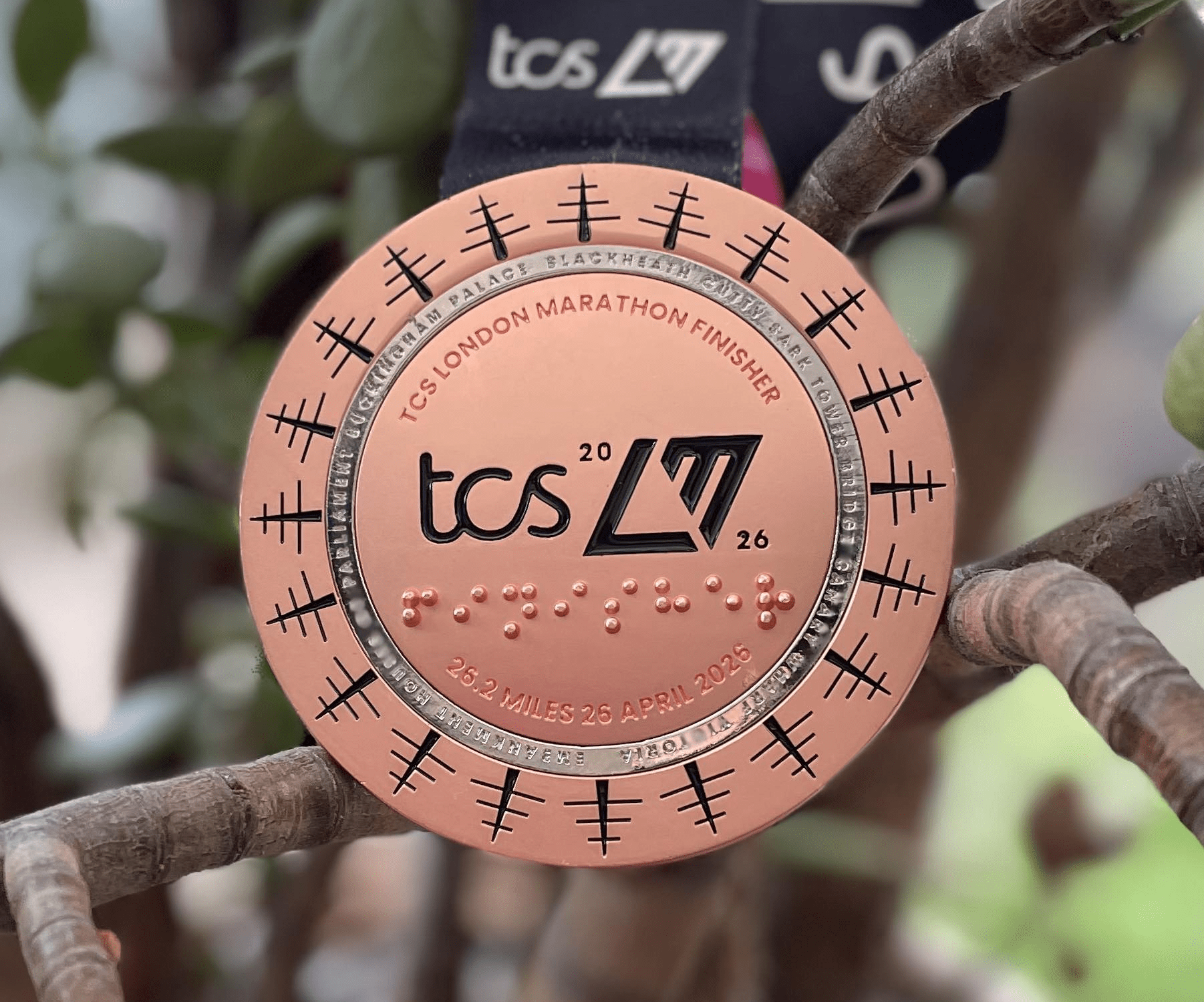
Sometimes I sit and wonder whether I’ve already ran my fastest ever marathon time or whether I’ve still got a faster time in my legs. I don’t lose sleep over it but I just know that I’m not yet at the point where I know my best is behind me and I can run just for the sheer “joy” of it in a dinosaur costume and not bother how long it takes.
I used to think that life appeared easier as you got older.
I’m not convinced that it actually does.
Here’s a very quick write up of my London Marathon 2026, straight into my digital pensieve here and then deleted from my memory to free up a little space.
I don’t really think that marathons are the most interesting of subject matters, “and then I ran some more…”
it all falls apart around me, in real time, with me just watching and shrugging.
At the time of writing my marathon personal best is still 3.49 set back in 2018.
I’ve ran other marathons since then but they’ve always been part of a triathlon or an ultra-marathon and I’ve never had the opportunity to better that time.
New York in 2023 was going to be that real chance to improve my time but that’s another story altogether and you’re more than welcome to read about it.
My London 2026 marathon journey really started in 2025.
I suppose, technically it started in 2024 when I was successful in the ballot for the 2025 event – a ballot I’d only entered because other friends were entering and I didn’t want to be left out. Nothing like a little FOMO to get one motivated.
Ironically, I was the only one that ended up with a ballot place in the end.
To those of you that know me it’ll come as no surprise to discover that my training didn’t go according to plan and I ended up with an overtraining injury. Sometimes these things just write themselves.
My regular runs, that ultimately build to periods of marathon pace, were often run at marathon pace and my long slow runs just became long runs that were also at marathon pace.
Pretty much everything I did was done at marathon pace and ironically that’s no way to build a good marathon pace.
It’s rather embarrassing to write it because I can see it all unfolding at the time. Weirdly, I’m just powerless to do anything about it and it all falls apart around me, in real time, with me just watching and shrugging.
I’d often just stare at my run data in disbelief and at the small pile of fuel I’d not bothered to eat or water I couldn’t be bothered to drink.
It’s probably why I’ve never bothered with a personal coach – I’d just end up paying them money to shout at me and even then I’d still ignore them.
Anyway, come April 2025 I ran the Big Moose half marathon in a fabulous time but my achilles injury, that had come to light during my Land’s End to John O’Groats epic, had fully resurfaced and had made it quite clear that a PB at London just wasn’t going to happen and even completing the full distance there without a great deal of walking might be somewhat doubtful.
So, with a heavy heart I deferred my entry to 2026 and dreamed happy dreams of recovery, better-structured training and a super-strong 2026.
Deferral was simple – just let them know before midnight on the day before the event!
2026 just has to be the year to do things right for once.
Deferring the Travelodge booking however was the exact opposite.
As I’d paid in advance, I could change the date, but I couldn’t get a refund.
However, I couldn’t change the date to anything further than 8 months in the future – not long enough to just move the booking to the 2026 marathon weekend.
Also, you need to pay the difference in cost for any future booking and London marathon weekend is the most expensive weekend in the calendar.
In a fit of inspiration I changed my booking to New Year’s Eve as that was also an expensive weekend.
Later in the year I moved my booking forward from New Year’s Eve to London marathon weekend and just moaned about the additional cost until everyone got bored listening.
So, by Christmas 2025 the big reset had been done and it was time to step up the training for the 2026 event.
This time was going to be different.
This time I was going to stick to my plan.
The dog was going to love it.
My dog is faster than a speeding bullet but she’s not much of a jogger and tends to trot at a lovely 6.00 per km pace when she’s on her running lead.
However, that’s a wonderful training pace for my long slow runs.
So, on shorter runs I could let her off the lead to mooch in the undergrowth and then catch me up.
On longer runs I would keep her on the lead and she would hold me back to a sensible pace as the training distances climbed.
I forced myself into consuming fuel during the runs and hydrating properly. As I’m turning into an old man, I simply don’t have the time to keep doing things wrong.
2026 just has to be the year to do things right for once.
Everything was going swimmingly until the 9th March when I was actually awoken by the pain in my right heel – a foot and leg that had never ever troubled me before in my entire endurance sport history!
So, throughout March I switched back to cycling to maintain fitness, stopped the long runs and just popped in a few shorter, painful runs to keep the legs ticking over whilst I tied myself in mental knots wondering whether to defer once again as, surprise surprise, a PB was now clearly off the table once again.
This time it wasn’t my achilles but, according to Dr Google was a retrocalcaneal bursitis on my heel. Whatever it was called it was certainly painful and wasn’t the sort of thing that I really wanted to be training with.
RICE (rest, ice, compression and elevation) is the standard cure although I was training for a marathon so went with MICED (moaning, ice, cycling, elevation and drugs.)
As it was about time to book train tickets, I needed to finally make a decision and fortunately a few things just slipped into place.
Firstly, I decided to run regardless, as far as I could, and then hobble to the finish if necessary, collect my medal and call it a day. Not a brilliant plan but a plan all the same. (If I’m being honest I just couldn’t face the palaver of changing the Travelodge booking again!)
At the same time, well, just afterwards, I discovered that ballot place entries can only defer once and I’d already done that in 2025.
It would appear that fate had me down for either kicking the whole thing into touch or running (and possibly walking) in 2026 regardless.
Who am I to cheat fate?
it felt like all 59,000 of them jumped on the DLR to Greenwich
This put me in a very interesting position and was remarkably similar to New York in that I was taking a known injury into the event with me, planning to run until the wheels fell off and hoping that they fell off late enough that I didn’t have to walk too far to the finish.
Now, if only I could take a good look at my New York experience and try to learn from it…
Things I remember from New York;
- Running very fast early on and going, “wow!”
- Feeling comfortable running above target pace for the first 15km and still going “wow!”
- Feeling fatigued at half distance.
- Taking painkillers to numb the pain in my quads.
- Stealing KT tape off one damaged limb to stick on another.
- KT tape not sticking to sweaty legs.
- Walking in agony and a hobbling run to the finish.
- An official 4.04 time.
- Central Park
- The 9/11 museum and the Statue of Liberty.
- Clinging to handrails going up and down stairs for a week.
Could I perhaps try something different at London?
How about;
- Don’t try for a personal best.
- Ignore the pressure of even running for any sort of time other than a finish.
- Pick a sensible target and stick to it.
- Run slower from the start and don’t get carried away.
- See how I feel at half distance and pick up the pace only if it feels right to.
- Keep the pace slow enough that the wheels never actually fall off.
- Try not to get passed by a fireman wearing breathing apparatus and boots.
It’s certainly a different plan but who knows, it just might work.
So, train to London, tube to ExCel, pick up bib and shirt, clump around the expo, point to name on big wall of names, walk to Docklands,, watch ducks, book in to Travelodge, grab some carbohydrates and get an early night and try not to think about my heel and at which point running was going to become just too painful to keep going.
My heel was improving by the day and didn’t seem to have got any worse on my last few training runs. It didn’t feel right (it still doesn’t) but it had finally stopped hurting. Whether leaping into a marathon was going to change that had yet to be seen.
Race day.
I left Jane snoring and wandered down to Canary Wharf along with a growing stream of competitors. TfL were allowing free travel for entrants and it felt like all 59,000 of them jumped on the DLR to Greenwich and wandered up to Blackheath common to the starting pens.
There are multiple waves in various coloured starting pens all over Greenwich and Blackheath Parks that all take different routes from different starting points which then don’t converge until Woolwich. It’s probably the only way they can get 60,000 runners safely on their way and in a sensible time.
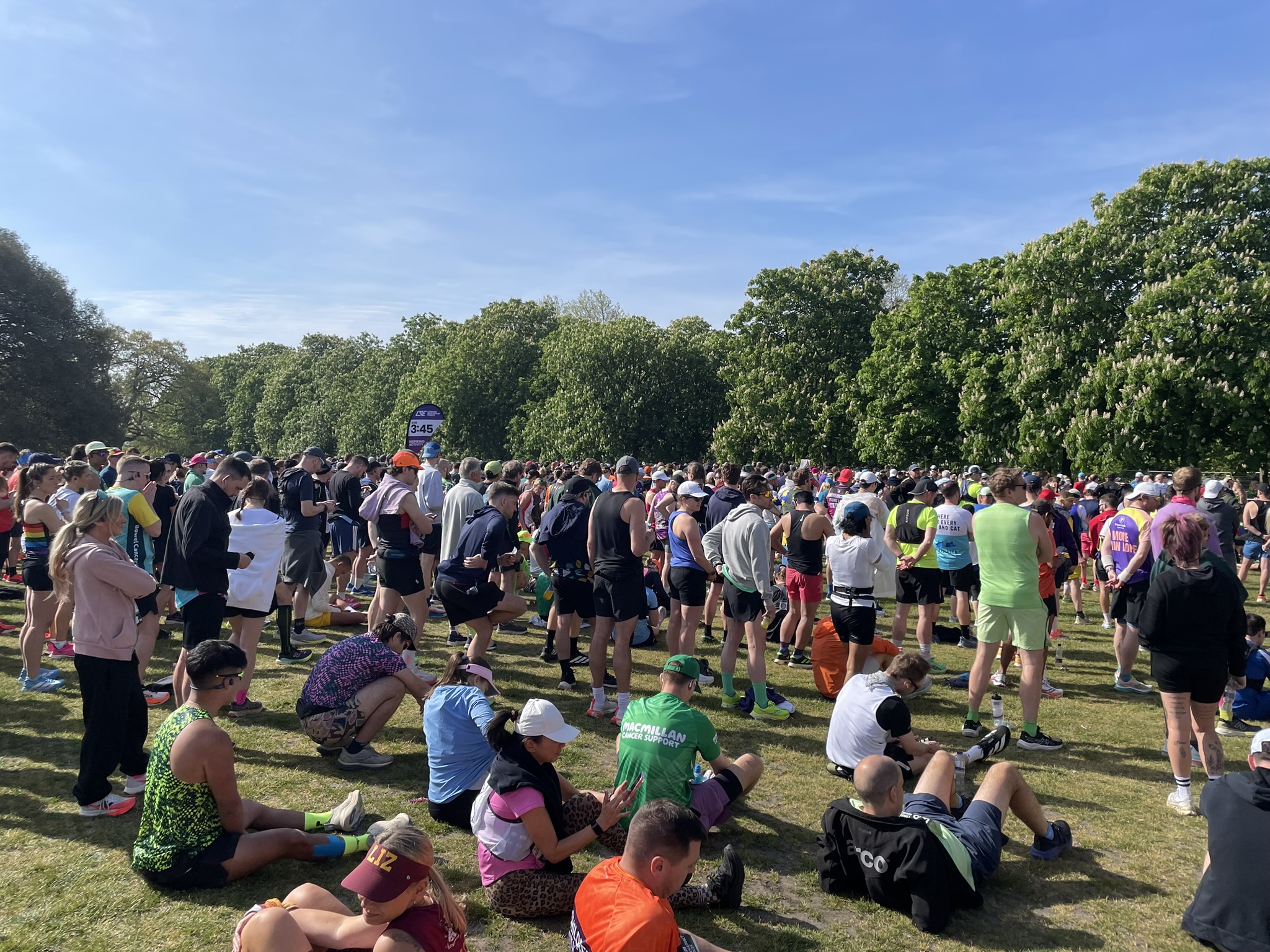
Lurking around in red corral, wave 4, wondering whether that pacer would tempt me.
My New York splits were 4.55 minutes per km in the early part at 150bpm and then an uncomfortable finish in 4.04.
For London, and stick with me here, I simply decided to run at a target heart rate of 140bpm. My last shakedown run suggested that would translate to a 5.30 pace and give me a race time of around 4 hours.
I know that’s faster than New York but I was reasonably confident that I wouldn’t maintain the pace for the entire duration and it would tail off as usual and I’d end up around 4.15 if my heel didn’t play up.
I also knew that Greenwich to Woolwich was downhill and the first few kilometres were going to be at a slightly faster pace.
I didn’t want to just shuffle along in a five hour marathon just to get a medal.
I still felt the need to achieve something even if it was only the fastest marathon I’d run with a dodgy foot.
So, stood in the wave 4 start in the red zone I popped a 4 hour marathon into my watch as a target time and distance, shuffled along Blackheath Avenue, dumped my hoody (and a cinnamon whirl, sorry) in the Salvation Army bags, turned onto Charlton Way, shuffled some more and hit the button as we crossed the line.
I apologise now for spouting data from here on and being rather short on witty anecdotes.
And then I ran some more…
Start to 10km
This is effectively Blackheath to Cutty Sark.
Unsurprisingly the downhill start made running easy with the first 5km coming in at 25.36. I wasn’t bothered – I was expecting this.
For a pleasant change, most of the runners around me were doing a similar pace and there was no real jostling for position. It was tight. There wasn’t a lot of space but, if anything, it urged me to ease back just a tad and stick behind those in front.
Another stream of runners from the blue and green waves joined us from our right at a junction and after a few hundred metres the two streams merged creating an even more packed crowd of runners and far more jostling opportunities.
We also came to the first of the water stations where, for some unknown reason water was being handed out in bottles with flip caps rather than paper cups.
Unsurprisingly, like every event with bottles, a missed bottle collection and a full water bottle rolling through the thousands of legs always results in a rolled ankle or worse and a pile of bodies on the floor.
Paper cups never do that and can all be scooped up and recycled.
It’s something of a mystery…
10km came up at 52:20, well ahead of target but right at the point where I had to reflect on my previous events and take a moment to bring back my pace a little and start to run to target rather than just think it was all too comfortable at this faster pace.
I can’t believe how mature I’d just become and how well-behaved I was being! I was a changed man.
10km to 20km
This is effectively Cutty Sark to Tower bridge.
Cutty Sark is narrow, so it is very congested. The funnelling effect slows down the pace and there’s no scope to pass other runners so you just have to stick with the crowd until it opens out again – no bad thing for me as again it forced a slightly slower pace.
Having run the first 10km slightly ahead of target I chose to stick to my current pace rather than think of any change of plan.
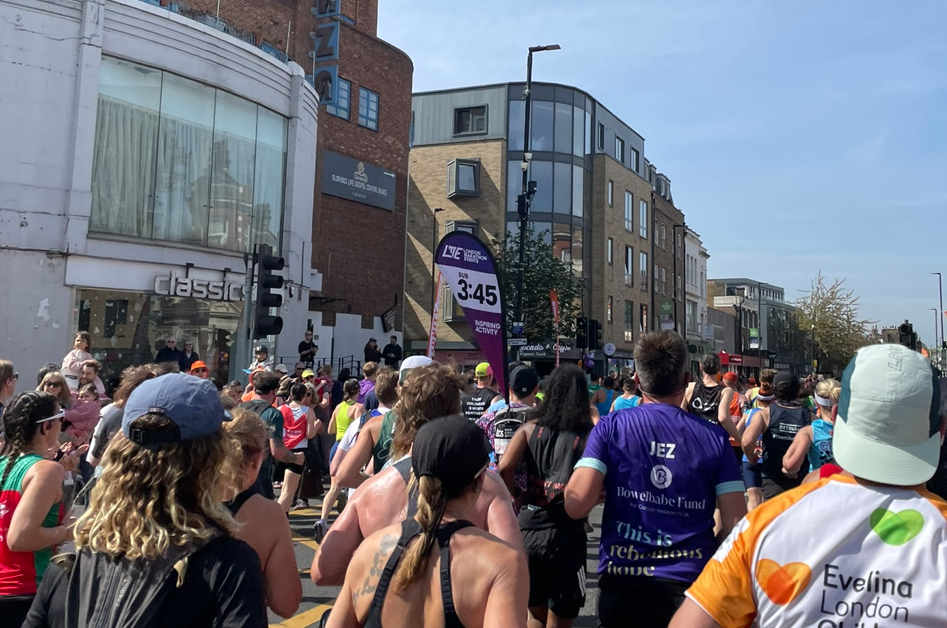
Horrified to be still with the 3.45 pacer at 18km
20km came up at 1.47:55, a nice solid 55 minute 10km and pretty much bang on target.
20km to 30km
Tower Bridge and through docklands.
There’s a lot going on at Tower Bridge. It’s just about halfway, it’s VERY picturesque, the course turns right down East Smithfield and runners returning from Docklands run the other way down East Smithfield making for a massive pile of runners and supporters all around Tower Hill.
It is just a wall of noise with a great many drums – some of them even playing the same rhythm.
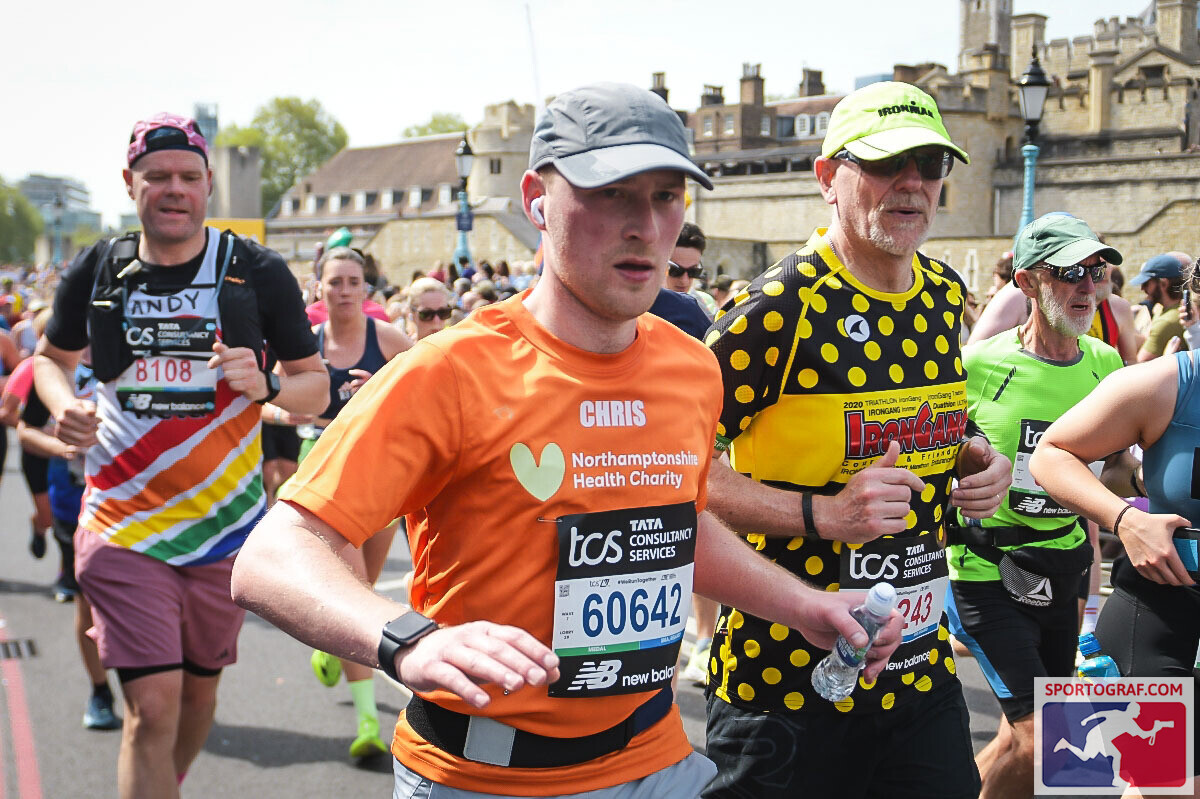
I’ve only ever met Chris and Andy once and we posed just for this picture.
From Tower Bridge it’s Wapping, Shadwell, Limehouse, all rather nondescript London suburbs – especially when running through them on crowded streets – before heading south onto the Isle of Dogs and back up to Canary Wharf.
30km came up at 2.43:00, another 56 minute 10km – that’s three now and the “easy” bit is pretty much over. Traditionally this is where things start to fall apart for me.
30km to Finish
Docklands back to the Mall.
The commentator earlier in the event had advised us not to get too transfixed on the “Canary scaries.” As I had no idea what they were it was unlikely that they were something I was going to worry about.
Even now, writing this after the event, Google is still not helping me with any translation.
At 19 miles into the course it’s probably a little early to be “the wall” that some runners choose to “hit” so it might forever remain a mystery.
Canary Wharf was however rather “scary” for different reasons.
The GPS signal was totally sketchy and my watch was really guessing as to my location at times. I ran kilometre 31 in 4:27 and then proceeded to do the same for 32 and 33.
In reality I did no such thing but my watch had me leaping all over Canary Wharf like some Red Bull-fuelled kangaroo.
By kilometre 34 things were back to normal, but I was now about 1000m ahead of the course on my watch and I was trying to do mental arithmetics as to my true pace.
My legs were now starting to hurt too.
Weirdly it only started when I removed one of the three energy gels from my left hip pocket. Running thirty odd kilometres with the pressure of three gels in there was ok but once I removed one it all started to hurt.
With hindsight I should have shoved something else back in the pocket but that didn’t occur to me at the time and of course, it might not even have helped.[1]
I walked my first water station at 35km to ensure that I safely removed a salt tablet from my pocket without losing my phone or the tablet and thus guaranteed myself a tablet, a drink and a little walk.
Interestingly the walk was actually more uncomfortable than the running, so I was back shuffling along pronto.[2]
Even with the discomfort I was still shuffling along at target pace. All that had really happened was that the bouncy, happy jog at 140bpm had become a sluggish, painful run at 153bpm.
No one watching would have looked at me and thought I looked comfortable though.
Later water stations were also supplemented by Lucozade Sport stations, one of my favourite beverages, especially if they’ve got them in the pound shop.
I walked the Lucozade station at 40km so that I could collect and consume two cups of the precious nectar without spilling any of them down my shirt. I’m not convinced that I succeeded.
40km came up at 3.41:18, a 58 minute 10km but the GPS glitch means that its accuracy is uncertain.
Despite the GPS glitch, the finish line came up at 4.01:27 regardless and at a distance of 43.32km, 1.12km further than a true marathon.
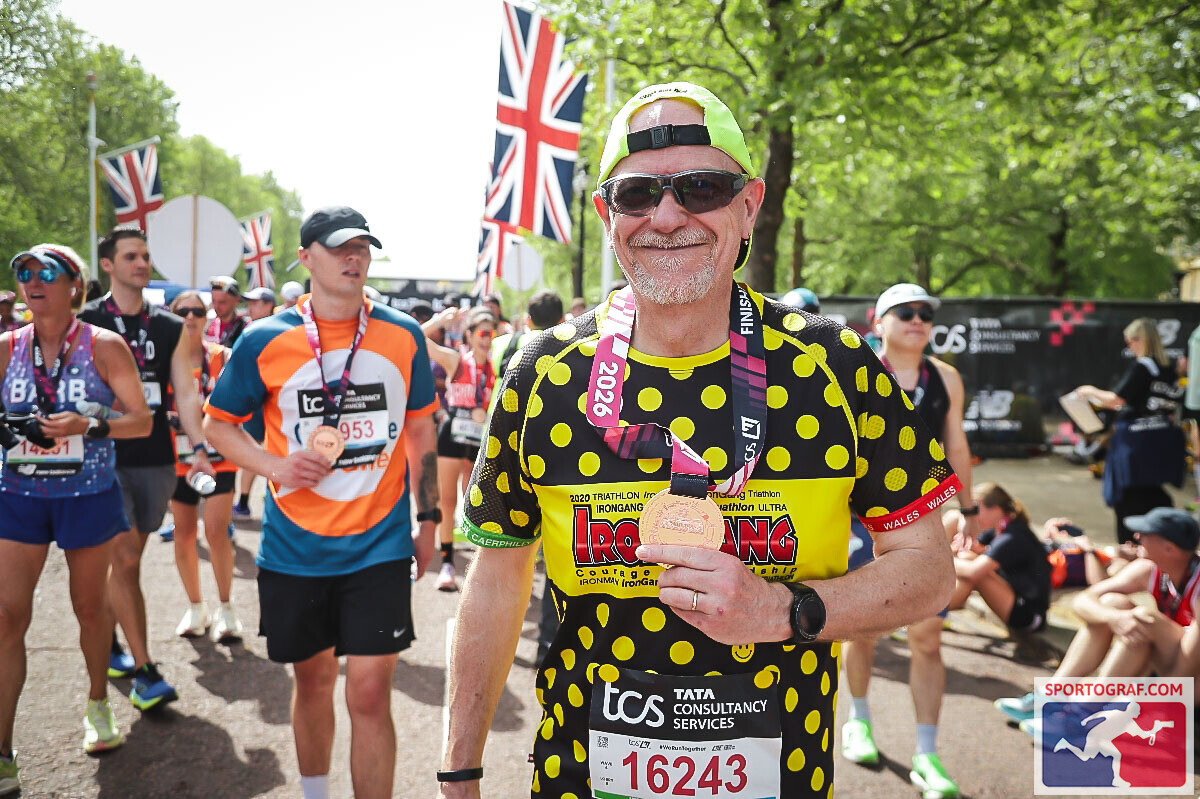
Looking far too happy at the finish.
Aftermath.
You can’t run a marathon without some sort of postmortem and the take home is pretty clear.
I took injuries with me to both New York and London, both of which robbed me of about six weeks of training and a potential personal best.
In New York I ran at a comfortable pace, felt depleted at half distance and then struggled onto a walk / run strategy and finished in 4.04.
Following the event I struggled with stairs for a week.
In London I ran a controlled pace from the start, felt good at half distance and walked just two hydration stations and finished in 4.01.
Following the event I struggled with stairs for a day and then went for a jog three days later.
What is now rather obvious is that I still haven’t finished running marathons.
I’ve at least another one to run but I’m seriously considering running another four and getting a rather nice medal…
[1] They say, “nothing new on race day”. Well, my shorts have vertical gel pockets in the rear and what did I do for the first time ever? Yes, I crammed 2 gels in each pocket rather than one. The moment I started running that weight of the extra two gels had my shorts bouncing up and down, especially down and halfway off my arse.
The first 1km was spent hoicking up my shorts and trying to tie the waistband string ever tighter.
[2] This was something I’ve never experienced before. My legs absolutely hated stopping and walking. In fact, my legs didn’t really want to walk. Just starting a shuffling run felt far happier than walking. It was as though they’d developed a cadence of their own and were only comfortable running.

