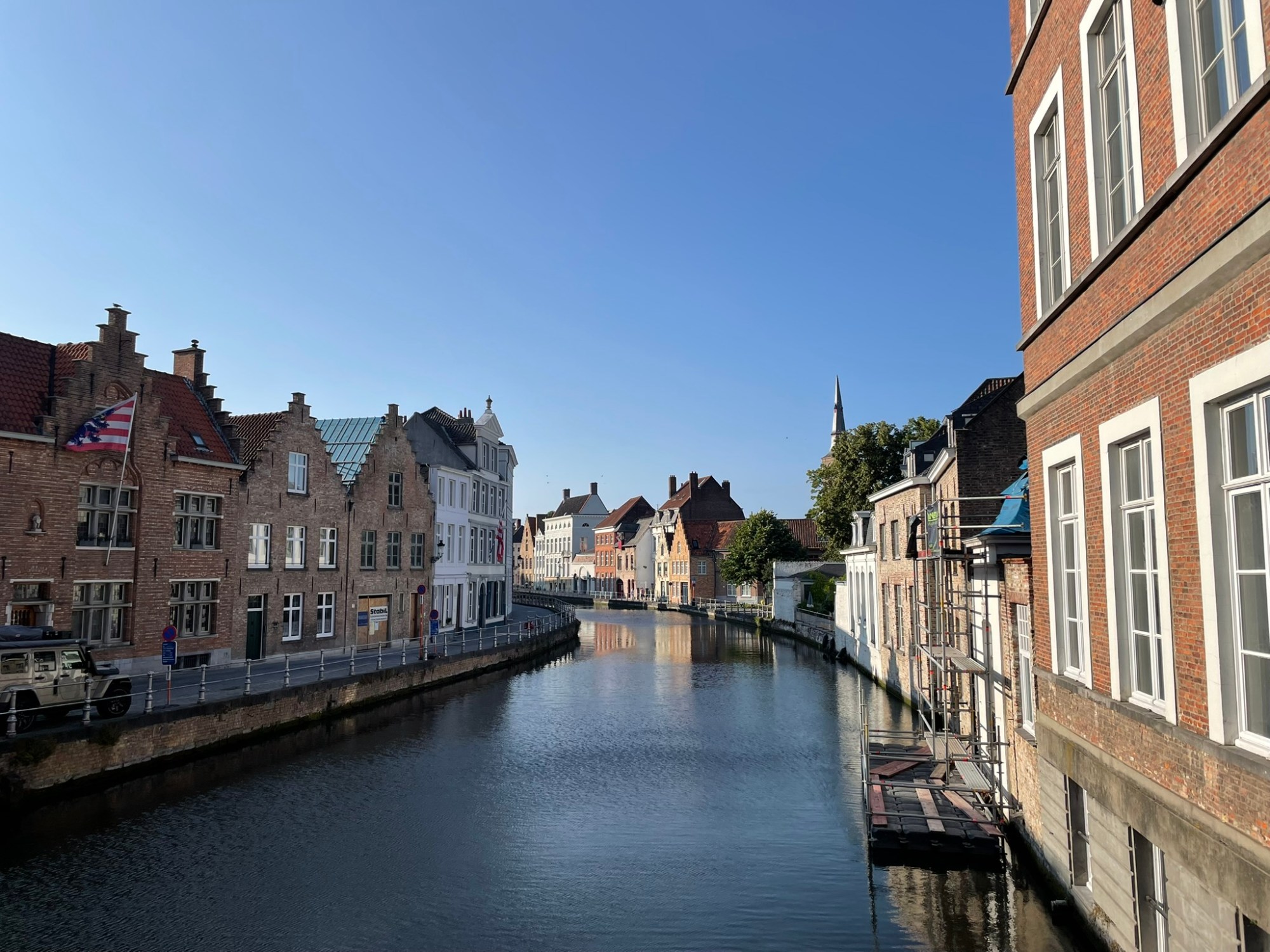
Otherwise known as the Fridays Flanders Frontiers Foray 2025
In the true spirit of cycle touring, everything starts at the front door.
There’s no chance of accidentally leaving anything in the car because everything is already with you, and when I say everything, I think and I hope, I mean everything.
Of course, you can still end up at the ferry and realise that you’ve left your passport at home, but, having done this often enough now, we are rather good with checklists – and when I say this, I mean cycle touring, not leaving our passports at home.
I find that there is something rather “nostalgic” about locking your front door jumping on your bicycle and then cycling to France, albeit with the odd train or ferry along the way. To be fair I’m not convinced that our older generation of cyclists didn’t, in some ways, have things rather easier. Travelling with a bicycle used to be a common occurrence whereas nowadays, as I discovered on my LeJog journey, trying to secure a space for your bicycle on multiple trains using multiple operators can be a very frustrating thing. My rose-tinted goggles show a world where the jolly cyclist could just turn up at the station and jump on a smoky locomotive, hauling a train of carriages, all expressly there for the purpose of carrying cyclists on their merry way to traffic-free, rural roads.
It is rather ironic that these days when chatting to fellow train passengers, they are somewhat flabbergasted to discover that you are on your way to France, on a train, for the week, with all the luggage you need strapped to your bicycle.
I’m never sure which bit they struggle with; the riding a bicycle bit or the carrying enough stuff for a week on a bicycle bit.
I’m sure they’d struggle if they knew how few shirts and pants I’d taken.
There is no ceremony at this point nor any particular shouting.
This was to be our second tour with the Fridays. Last year we went to Normandy and looked at the relics left behind from the war. This year we went to Belgium and looked at the relics left behind from an entirely different war.
This earlier war seemed to be so much worse.
The Fridays are a London cycling club with members from all over the country. As I understand it, they’re the “Friday Night Ride To The Coast Club” but they were struggling to fit it all on a cycling cap in a readable font.
Friday night rides involve (funnily enough) riding to the coast through the night, grabbing breakfast at the destination and then getting the train home the following day.
They also do an annual tour – which we were now on, again.
This doesn’t start on a Friday night nor go to the coast although it could and it might.
The Fridays have a not-so-secret system for successful group riding – no one other than the ride leader knows where they’re going. To add to the excitement, sometimes even the ride leader doesn’t know where they’re going.
There are no published routes for the day; that way it keeps everyone on their toes.
Now, you may think that that’s a recipe for everyone getting pretty much lost but in fact it isn’t. The club uses a group riding technique that features way-markers and an “all-upper” – whose job it is to energetically shout “all up” at appropriate, yet quite specific moments.
The ride leader (the only one that knows the route) drops the second rider at strategic points along the route to waymark. In theory, a way-marker will be placed at every possible point of potential route confusion. The first way-marker will stay in their position, no matter what, like an obedient soldier, until the all-upper arrives, shouts “all up” and does the secret wave. At that point the way-marker is free to ride up through the group or remain near the back with the all-upper.
If you fancy a ride with good pace you then simply ride quickly through the group until you’re number two again and repeat the process.
If you fancy a leisurely ride then you simply let everyone else ride ahead of you and never become number two.
Every once in a while, the ride leader stops and allows the entire ride, including the all-upper to reform as one.
There is no ceremony at this point nor any particular shouting – usually.
In theory, on a ride with the need to waymark a lot of points, it is possible that the only two cyclists actually moving are the ride leader and the all-upper. All the rest could be stood at junctions waiting.
Of course, at this point the ride leader doesn’t have a number two and must stop before the next waymarking opportunity.
The system is not foolproof, as we discovered on Tuesday’s Antwerp loop, when we lost the all-upper and the penultimate rider. To be fair, it took some doing but we got there eventually. The trick is to not drop a way-marker at a junction, put on a bit of a spurt, and see what happens…
On the bright side, a mobile phone call soon put things right.
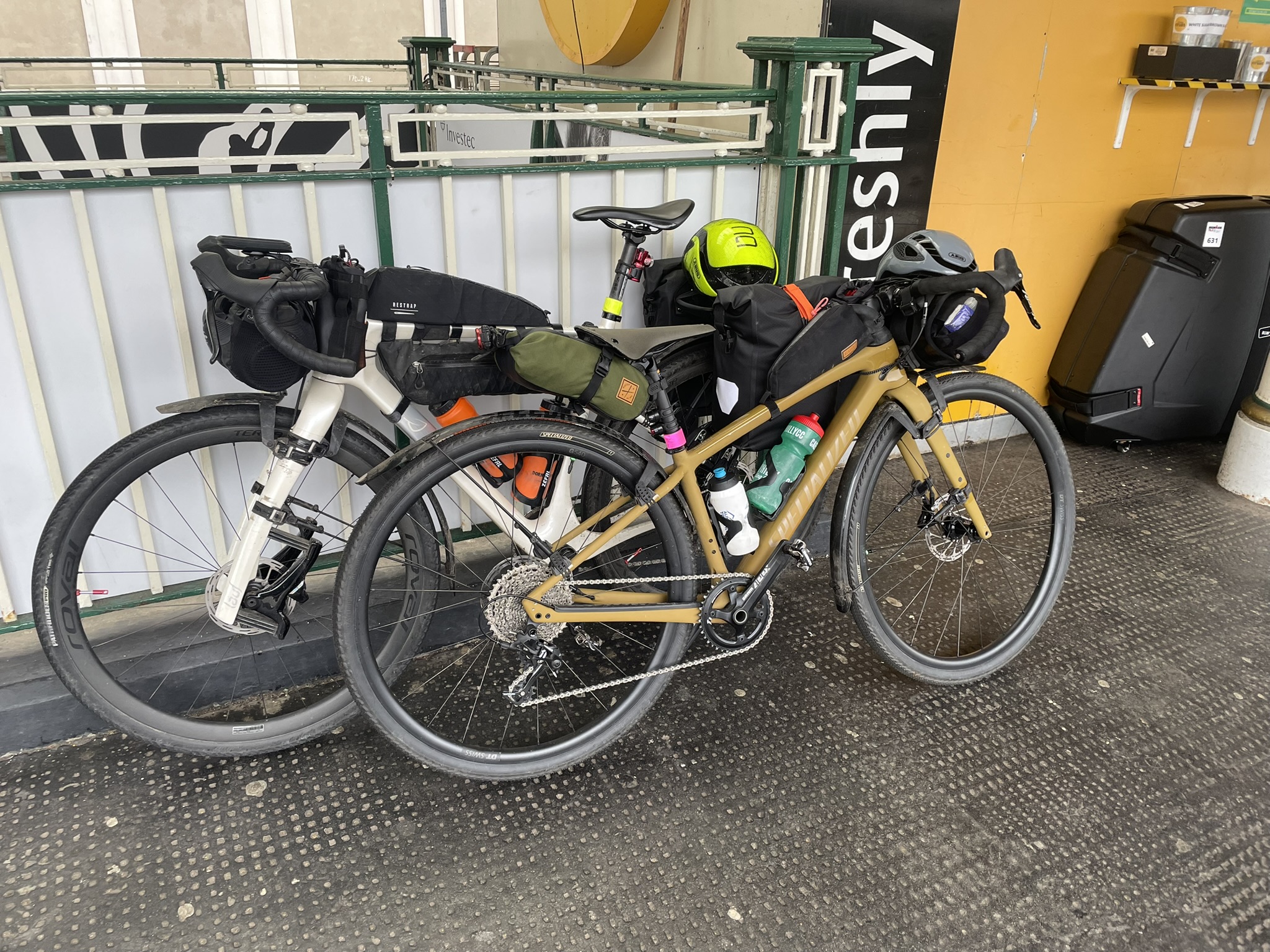
The bicycles taking a few deep breaths before squeezing onto a train.
What is also rather fascinating / confusing (take your pick) is that cyclists have their own vocabulary and signage to warn fellow riders of upcoming vehicles or hazards in the carriageway.
Very often when riding in a large group it is not always easy to spot things such as potholes, lumps, bumps and other potentially dangerous things in the way. Therefore, there are regular calls or signals from riders so that the rest of the group can hear and see what is going on around them to avoid having to take drastic avoiding action.
Many of the signals seem to be universal – “hole” or “bollard!”
However, as we discovered on our Normandy tour last year, some of the calls are definitely not.
Where I usually ride in South Wales, a car or other vehicle coming towards the riders has the call, “car up” which seems reasonably logical as the car is up the road ahead of you. Conversely a vehicle coming up behind the riders has the call, “car back.” These can of course be tweaked, depending on whether the other vehicle is a car, a motorcycle, a bus or a truck. The first confusing call on any Friday’s tour is the call, “bike down” as a bike is coming towards you. Of course this is invariably followed by the call, “car up” with no car in sight and then you realise there is actually a car behind you.
So, ‘car up’ is also ‘car down’ and ‘car back’ is also ‘car up’.
‘Bike down’ is traditionally an accident and means that someone is on the floor!
Despite the extensive briefing notes for the tour, most of which don’t get actually read (sorry) there was nothing within the notes regarding this lexicon of traffic movements around the group of riders. It goes without saying that every single rider that made any single call was of the opinion that their call was the correct call and that everyone else was calling things incorrectly. Now, those with a sharp eye for numbers will soon realise that if the only call you ever made was, “car up”, you may or may not be right half of the time as opposed to being incorrect most of the time.
If I remember rightly, by day two of the tour we’d scrapped those calls entirely and referred to two new calls, those being, “car front” and “car back”. Now these may seem totally obvious, yet here I was on a second Friday’s tour still having the same “problem” with other riders shouting the “wrong” calls. It won’t come as any surprise that when you are riding with other riders who are familiar with their own calls when they try to adopt a new call, they fight their subconscious habit and also get the new call wrong so many times that we had no idea what was coming and from which direction it was coming.
It’s always good to keep everyone on their toes.
For the purposes of the exercise, just shouting “car” was usually enough and most people were happy.
Like the pronunciation of scone, it would be an interesting exercise to see where the regional boundaries lie for “car up”. Maybe one day I’ll take the trouble to investigate!
So, day one of the Belgium tour was going to be a longish day, starting in Caerphilly and ending in Dunkirk and we’d be at the mercy of train operators and ferry operators for most of it. We had an early, empty train from Caerphilly to meet an early train from Cardiff where, as usual, we attempted to cram two full-sized bicycles, with luggage, into a space designed for two tiny bicycles without luggage, or quite possibly even without wheels and handlebars. As we were sat near to our bicycles, we were close enough to hear the tutting every time anyone had to make their way past them.
Even on a train, people are still tutting at cyclists who are just trying to mind their own business.
Leaving Paddington station, we bumped into Claudine and Ceri, who’d also just arrived from Wales, possibly even on the same train, and we all trundled our way to St Pancras through the nightmare that is London traffic. They were on an earlier ferry and dashed to get their train. We had built plenty of tolerance into our journey but at the ‘expense’ of advance tickets. We dashed to the bakery instead. With hindsight this might have been the last of the dashing this holiday.
A high-speed train whizzed us most of the way to Dover at a somewhat alarming velocity. The train we jumped onto, to finish our leg, had Sal and her bike too. Both train and Sal were far less alarming. Why we were changing trains was something of a mystery until I remembered that it wasn’t me that had booked the tickets.
Our ferry was delayed, and we stood in lane 43, in the wind, until our ride turned up and we watched more than twenty Stagetruck trucks disembark. Weirdly, Google was absolutely no help in telling us who was touring the UK and needed more than 20 trucks.
This is one of life’s mysteries that we’ll never now solve.
Either way, it must have been a huge gig – somewhere.
As we were getting into Dunkirk relatively late and we couldn’t be bothered searching for food and eating late, we upgraded to the premier lounge on the ferry. (Retirement goal #21)
Previously when we’d done this, on P&O, we’d managed to stuff our faces and leave with our bags crammed with sandwiches and crisps for the following week. The system with DFDS was somewhat more civilized and they look our food order rather than providing a “takeaway” service. The food and drink were still all included but we were limited to loading up with biscuits to go and eating far more cake than we really should have done to feel that we’d got our value for money.
It didn’t come as a shock, as I’d looked at a map before we left, but I was still rather bemused to discover that Dunkirk town was 18km from Dunkirk port. You’d have thought that the two places might have been given different names entirely. You only need to take a glance at Google maps to see that the Dunkirk ferry terminal is actually at Loon, which, I’m sure you’ll agree, has a thoroughly acceptable ring to it, particularly the noon Loon ferry.
The cycling journey from ferry to town, ignoring the major roads, takes you through the bleak petrochemical and mining area that Sal rather accurately described as somewhat “Wes Anderson” esque.
I’m good with bleak and petrochemical though. Sometimes you can get a little bored with picturesque.
Anyone that has met Jane knows that she has little legs. To be fair, she’s just little, it’s not just her legs. Little legs means a smaller bike, lower seat heights and a continual compromise with luggage.
Last year’s tour had resulted in a “bodged” rear rack for Jane and a copious use of string to tie on additional bags and prevent items dragging on mudguards – not ideal.
When I say bodged, it was one of my creations so was actually rather impressive and worked very well. My bodged is often the touchstone that others aspire to achieve.
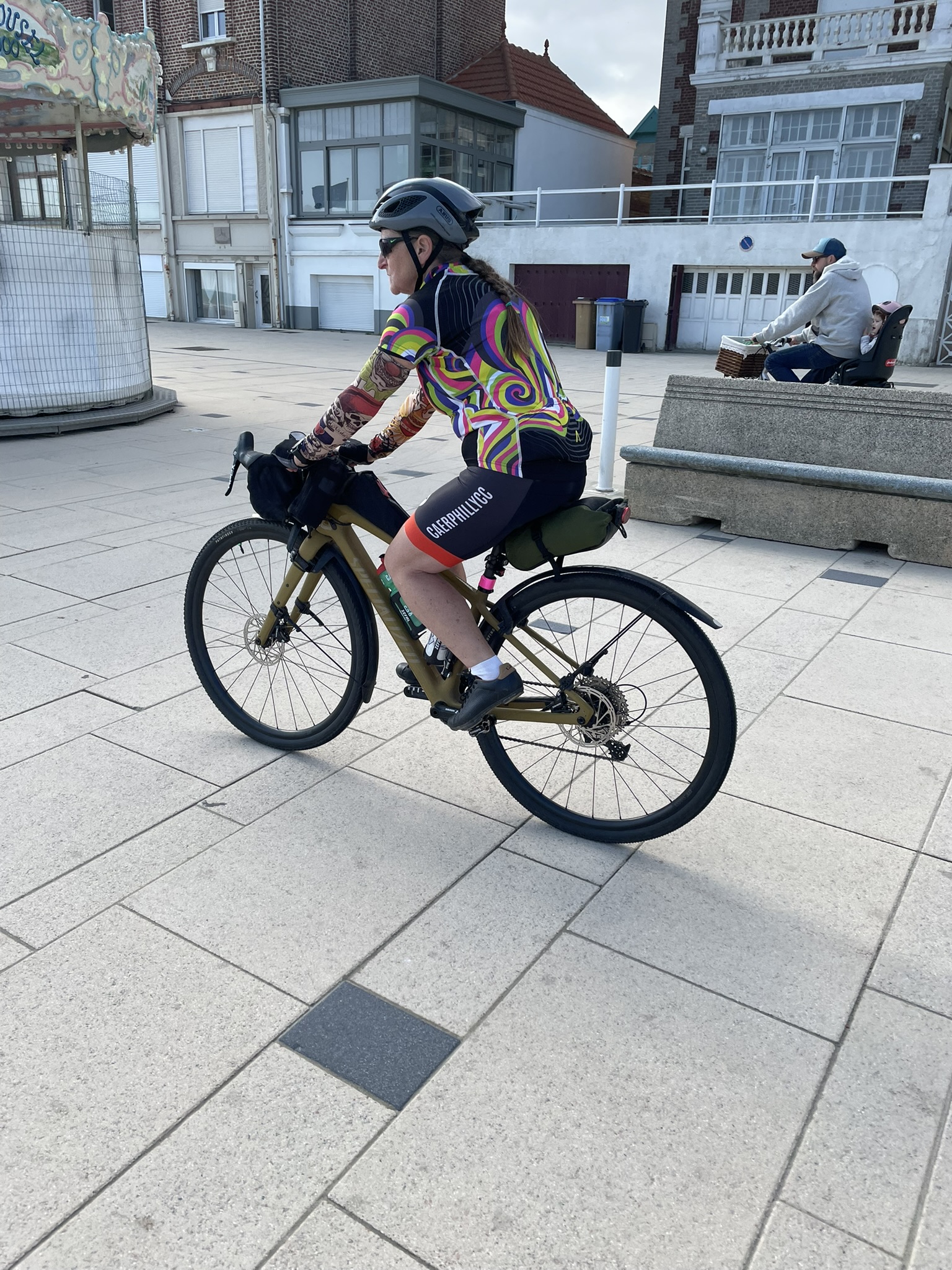
Jane sporting her lightweight, minimalist, touring set-up.
This year we invested in some lightweight panniers and did a trial pack. It turned out that I was going to be carrying pretty much ALL the luggage leaving Jane free to carry just her waterproofs, her water and a wry, see-what-I-did-there, grin.
Well, I’m not one to moan but my bicycle seemed to have become something of a porky beast.
In a bid to save a little weight (without the benefit of a crystal ball telling us that we were to carry our jackets, waterproofs, overshoes and over-trousers through a 30°C Flanders heat for a week) I reviewed the packing list and removed from it one of the 4-way USB chargers thus saving myself a staggering 50g from my burden.
Now, when I bought these chargers the year before, I’d tested one and put it into my luggage. This year I put both in and then removed one. Of course, I now know that I removed the tested one, leaving the untested one to come to Flanders with us and, unsurprisingly, it did not work.
Luckily, I’d also packed an emergency 1-way USB charger that now had the not-enviable task of charging 2 iPhones, 2 watches, and 2 Garmins each evening for a week.
I was well aware that by the first evening in Dunkirk, that 50g was starting to look far more useful than the North Face Thermoball jacket.
Our first holiday task was obviously to try and find a USB charger at the first opportunity.
She’d decided to arbitrarily alter the priorities by tracking down a restaurant, a meal and a glass or two of wine.
There seems to be a common “habit” amongst the Fridays to book accommodation at the IBIS hotel, presumably as a guarantee of consistency across the globe.
We like to treat every hotel booking as something of an adventure with the only stipulation being coffee-making facilities in the room and somewhere to safely secure the bicycles.
Imagine my surprise when opening up our room in Dunkirk to find absolutely no coffee-making facilities.
Despite a thorough search of cupboards and drawers there was no sign of a kettle.
We checked them twice.
Day 0 was starting to earn its place in a possible post-tour comments section.
Anyway, the week’s itinerary looked something (if not exactly) like this;
Dunkirk, Bruges, Antwerp, Ghent, Ypres, Dunkirk with an extra day and an extra loop in Antwerp if you wanted it (the loop, not the extra day).
So, even though I hadn’t managed to get my morning coffee until breakfast, I wasn’t going to let it spoil my day. We arrived at “Fridays Central” on time for departure and met the rest of the tour members, many of whom we’d toured with the previous year.
Without a formal greet & meet session we were left to work out names using the traditional, “I’m terribly sorry but I don’t know your name” technique.
With my dodgy memory I must confess that I was still using the same technique on day 7.
Day 1 can only be best described as a day at the beach.
I’ve never been to Belgium before and I’m somewhat ignorant of its purpose.
I know it makes chocolate, Leffe beer and hosts the Belgian Grand Prix but other than that my knowledge is pretty thin.
I didn’t even know it had a beach.
My geographical imagination had the Belgian coast as some industrial docklands, full of containers, smoke and belching flames, opposite the English channel and stretching up to the Netherlands.
What I didn’t expect was mile after mile of golden beaches.
I lost Jane at the lunch stop in Nieuwpoort where we’d planned to track down a USB charger as our first priority. She’d decided to arbitrarily alter the priorities by tracking down a restaurant, a meal and a glass or two of wine.
Of course, she hadn’t shared this amendment with me.
On the bright side, sharing my dilemma with a fellow tour member resulted in them lending me a spare USB charger that was in their kit. For all I know, it was their only charger and they just didn’t want to get involved in a domestic with the weird couple from Wales, particularly the feisty wife.
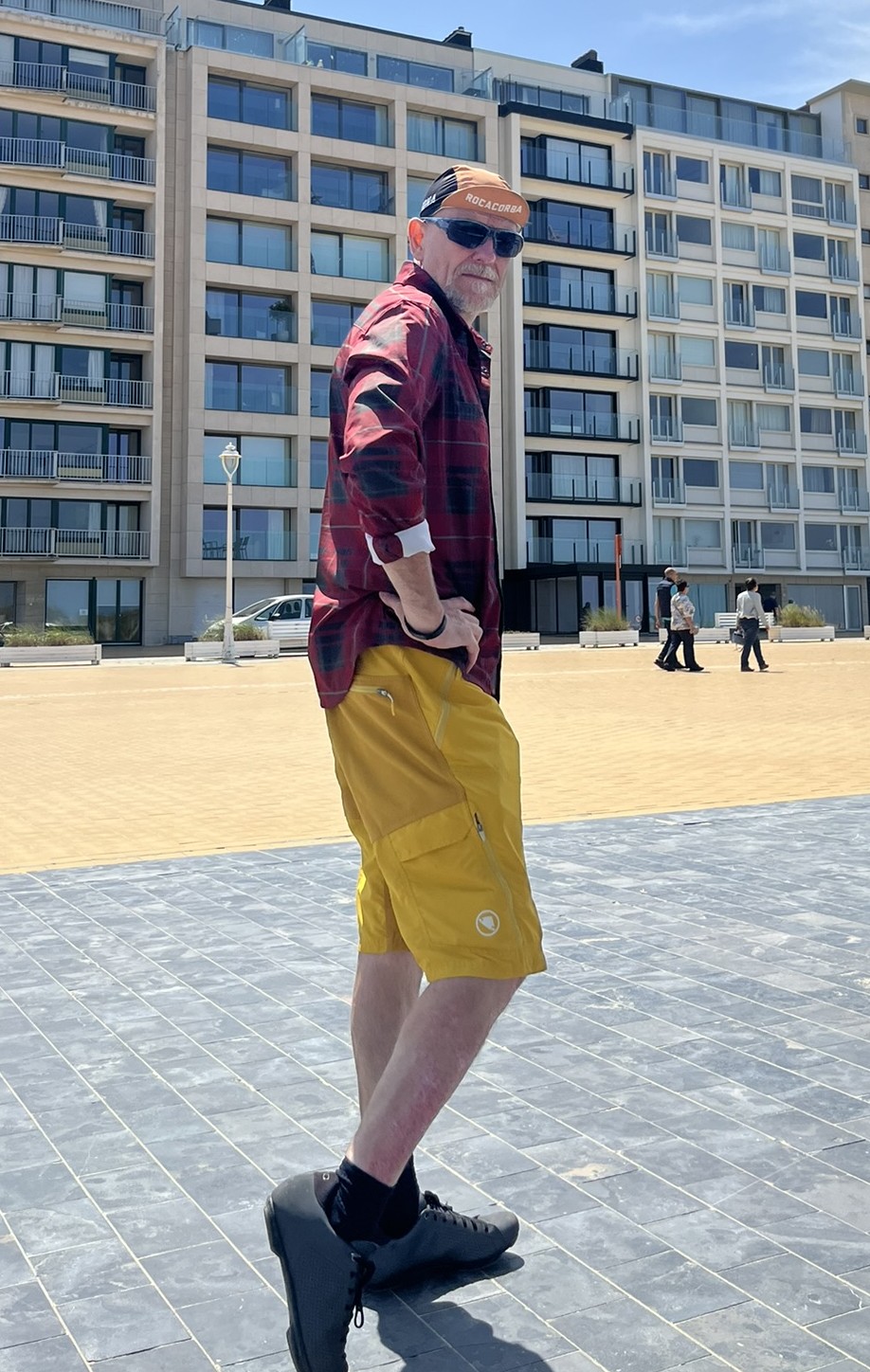
Sporting the shirt & baggies look at Nieuwpoort Beach.
My lunch was very much an afterthought as I’d been sticking to the plan as usual. It had the makings of a grumpy afternoon until we set off for the next leg and jumped straight onto a ferry!
Who doesn’t love a ferry.
This one was crammed with bicycles too.
By the afternoon tea stop, I can’t deny I was bored of golden beaches and children whizzing around the promenade on hired bikes, quads, tricycles and unicorns in every possible direction, simultaneously.
So, after tea (which is invariably coffee) at Ostend, we headed inland, picked up the canal and meandered our way to Bruges.
I was interested to see whether our hotel choice was going to pass the coffee facilities test…
I’m old enough to remember the Krypton Factor.
The hotel we booked in Bruges turned out to be a self-check-in with the check-in details sent to your email address (if you booked directly with hotel) or not sent at all (due to GDPR) if you booked through a third-party website such as booking.com.
So, we stood outside our hotel wondering how to check-in.
Actually, I was really wondering how I could justify going and getting a beer and letting Jane sort it out.
At that moment other guests turned up and opened the door allowing us into the un-manned reception.
There we found our pack, our keys and the now superfluous instructions on how to check-in.
Armed with our precious key we strolled confidently into our room for the night, a converted attic, to discover absolutely NO coffee-making facilities.
There was somewhere downstairs to store the bicycles though and the floor-level window in the bathroom, next to the toilet, meant that one’s morning ablutions could be undertaken whilst nodding at pedestrians – very continental.
Before launching Jane from the nearest window she pointed out that there WERE coffee-making facilities but they needed to be booked at reception before 10.00am the previous day.
Yeah, right…
After dinner we took a tour of Bruges to find out what time in the morning the cafes and even McDonald’s opened.
“After we’d left” was the answer. Bruges most certainly likes a lie in.
Day 2 was not going to beat me.
Up far too bright and early I realized that I was definitely having a coffee, even if I had to knock on the door of a sleepy local resident and persuade them to make me one.
As day 2 was to be a long day and we were leaving Fridays Central at 8.30am we had a small problem in as much that breakfast wasn’t served until 8.00am, leaving us very little time to get organized.
The sign on the breakfast room, “guests removing food from the breakfast room will be charged 10 euros” did not bode well.
So, in the grey dawn of Bruges I set off in a completely different direction to the night before hoping to smell someone, somewhere, grinding that naughty bean.
As I rounded a cobbled corner I caught sight of a vision that warmed the caffeine-starved cockles of my heart – a chap clearly scoffing a pastry from a paper bag and clutching a steaming cardboard cup of what must be coffee.
Being careful not to break into a run and startle him away, I headed nonchalantly towards him, trying to appear entirely normal and to casually ask him about his breakfast.
I didn’t need to.
As I further rounded the corner, the inviting lights of a charming little bakery appeared, and, once inside I could see their bean to cup coffee machine beckoning to me.
So, a couple of coffees, a couple of pastries and day 2 knew exactly who was the boss – for now.
It appears that Belgium has a great many wind turbines. I can only assume that this is due to having fewer nuclear installations than their French neighbour.
They certainly have wind – a distinct advantage for wind turbines. I’m not suggesting that we were riding in a gale – far from it. There was however a constant breeze, tickling its way around your undercarriage and obviously keeping the turbines spinning.
As the total ascent for the day was 219m, most of which was bridges over canals, the word that springs to mind is ‘flat’.
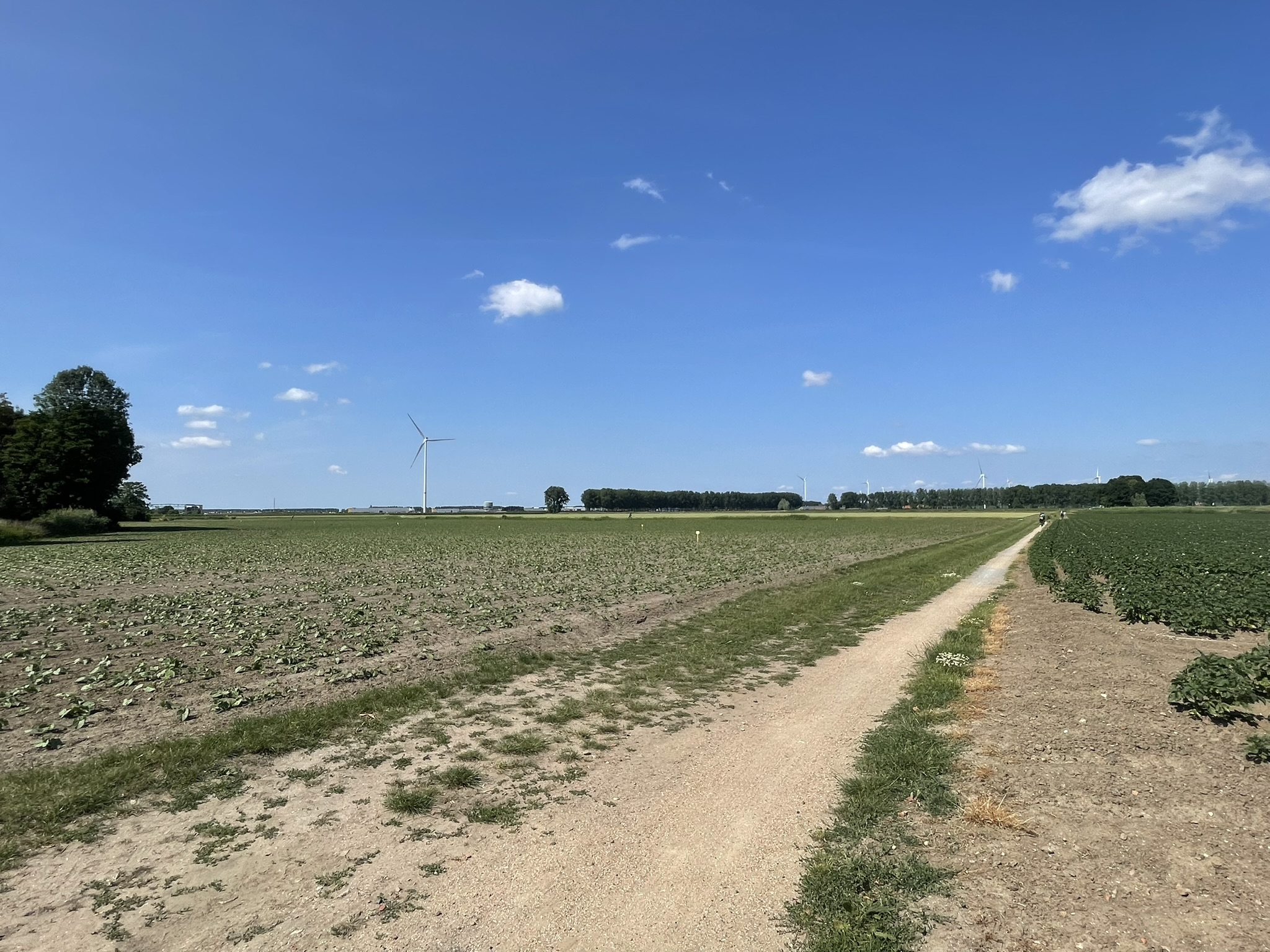
Comedy gravel section on prime agricultural land ruined by wind turbines.
On the subject of wind tickling its way around your undercarriage, it’s worth mentioning that Jane took great delight in now pointing out that my beautiful Rapha cargo shorts had become positively transparent around the arse-crack area, or, as she put it, “your shorts have gone all Mr Parry”, a reference to one of our former club members that wore his bibs long-past the stage where they were considered even slightly decent.
Being the sort of rider that likes to make his way through the pack and keep up a good average speed, I was now saddled with the extra weight of knowing that I would be exposing my arse-crack to the tour constantly – rubbing their faces in it as it were.
The other alternative was to stay at the back of the tour, hiding my shame from view.
In the end I came up with a simple compromise; I was on holiday and just didn’t care.
Besides, it’s not a bad arse-crack, even if I say so myself.
We lunched in the grassy shade, by an abandoned wharf, off the Ghent-Terneuzen canal and watched a couple of schoolboys do likewise. It’s fascinating, yet sort of predictable, that they ride traditional looking bicycles with panniers rather than mountain bikes or, heaven forbid, carbon road bikes.
Presumably, with the high-quality cycling infrastructure here, it’s an obvious choice for a great deal of the population. I can’t deny there was a pang of jealousy.
Finding ourselves crammed onto yet another ferry across the Scheldt was, of course, the highlight of the day. No one had mentioned boat rides before the tour, and this was technically the third now. They are such fun and remind me of my daily River Mersey crossing when I worked in Liverpool as a youth.
It was a challenge not to start humming Gerry & the Pacemakers.
Our hotel provided a delightful conference room to bed our bicycles down for the night and there was a kettle in the room. It was rather an upmarket hotel and came with a mini-fridge and bowls of mints throughout the establishment.
as though we’d lost a few in the night – perhaps Trump had bombed Antwerp?
We cleaned up and headed out for pizza.
Wanting a quaffing ale to wash the road from my dry throat, what I thought was the ABV of my beer was in fact the price.
It was cheap but it was also 8.5% – hardly a quaffing beer. Still, it certainly cleared the throat – possibly enough to break out in a song.
Day 3 and coffee in bed – finally.
It’s the small things that make the difference and it was worth the wait.
It was the first day that I turned the TV on, found BBC news, found that Trump and just bombed Iran.
I turned it off again…
Day 3 was an optional riding day, an architectural tour of Antwerp or simply a “do your own thing” day. We went for the Belgium – Netherlands border tour and boy, did we see a lot of the border.
It would, of course, have been far more interesting if there had been border guards, dogs and huge machine guns. As it was, we spent most of the day riding one side of the other of the border and sometimes over it.
Luckily, the lunch stop was in the Netherlands, so I had an apple & banana pancake with lashings of slagroom; frites are just so Belgian.
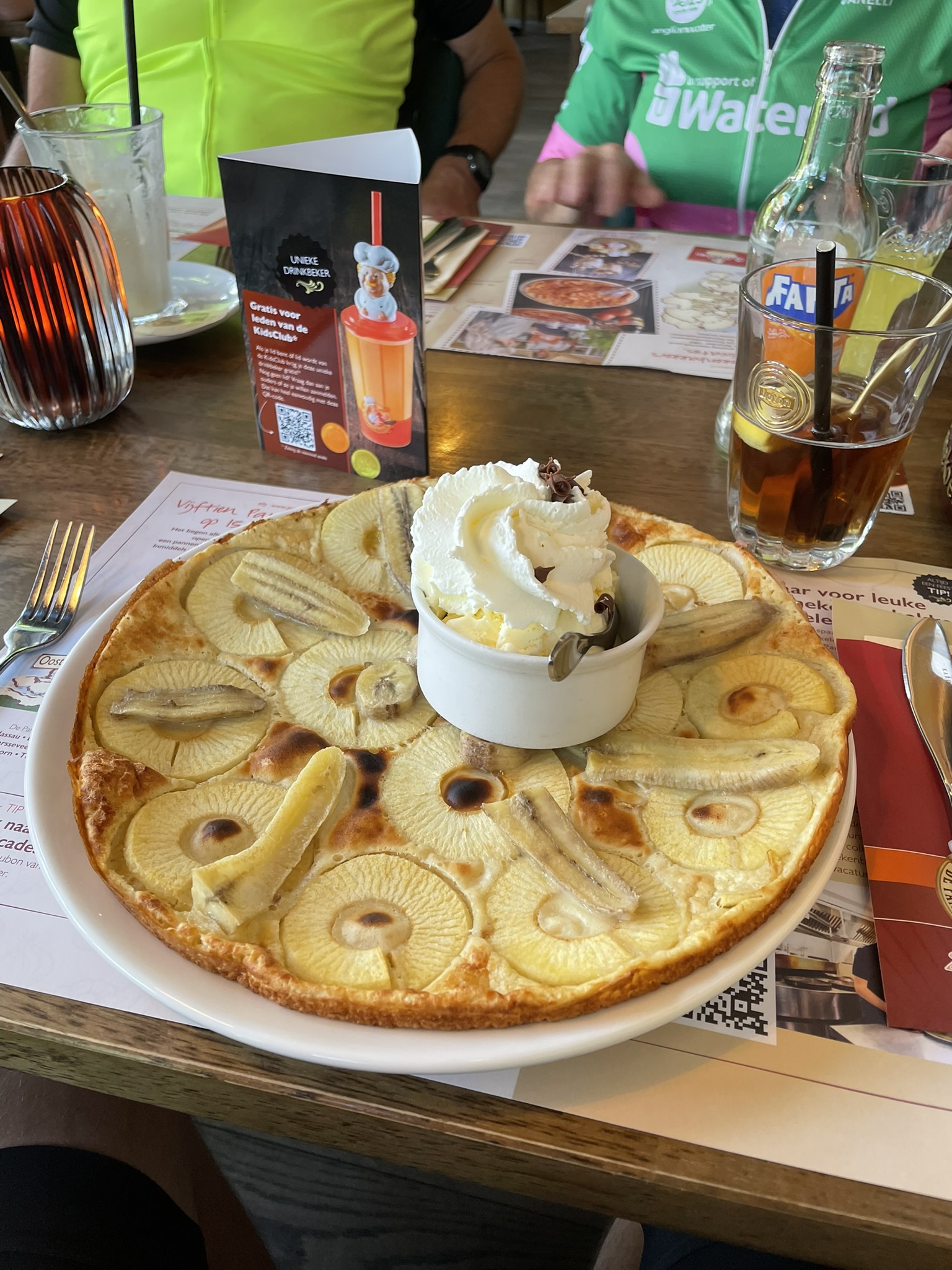
Just how do you get away with eating this stuff if you’re not riding 100km every day?
Apparently, there were 13 border crossings within walking distance of our restaurant.
As it was over 30°C we managed to find the one a pancake’s throw away and then found some shade instead.
We came back into Antwerp in the cooling shade of its huge canal, cleaned up and then went out for that perfect hot weather meal, Flemish stew with fries. At least we ate outside.
Day 4 and we were still in Antwerp, so I got my coffee in bed once more.
Trump hadn’t bombed Iran again, but I did hear that he said he had the best bombs – really great bombs, the best. No-one has better bombs apparently.
I rounded off my breakfast with a custard-filled chocolate éclair.
To this day I don’t know why.
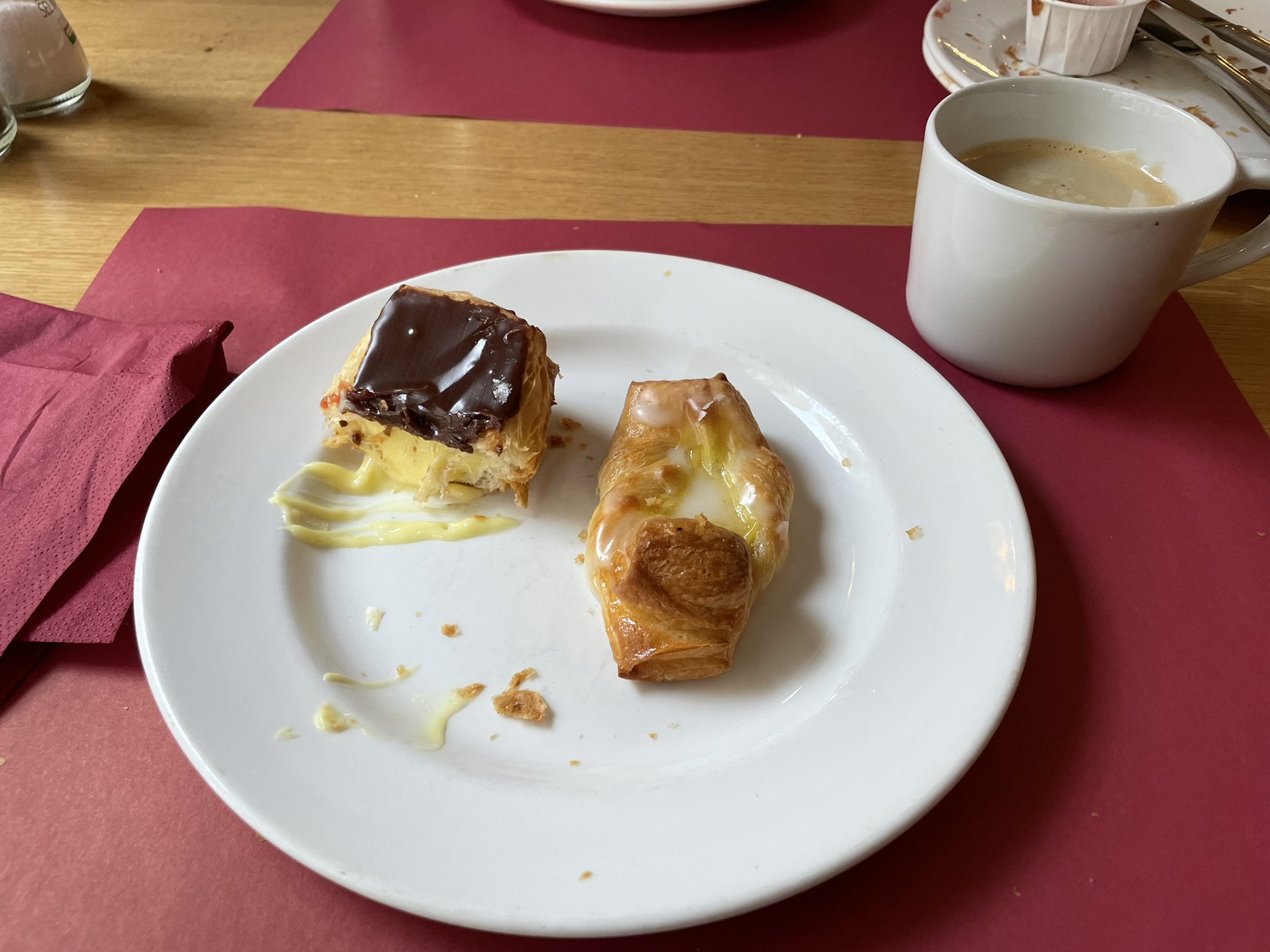
Post-breakfast dessert – just wrong on so many levels.
Even riding to Friday’s Central was an effort with my new-found, pot-belly of Belgian breakfast pastries.
Strangely, we were very few at Friday’s Central this morning, as though we’d lost a few in the night – perhaps Trump had bombed Antwerp?
It turns out that a group had already been “sent ahead”, for, as yet, unexplained reasons.
Well, it soon became apparent that we were crossing the Scheldt again and this time we weren’t taking a ferry or a bridge.
The tunnel under the Scheldt is rather deep and rather long and, most unusually, didn’t stink of piss.
There is a funicular to take those less mobile down from topside to bottom-side and, looking at the flight of stairs it was rather clear that cyclists fit into that category.
As the funicular is slow and rather small we now understood why the group had been split up into smaller sections to ease our journey across the river.
Like a sweaty game of Tetris we attempted to fit 8 bicycles into a compartment designed for 4. I think we settled at 5.
As the funicular compartment was a roll on, roll off format and our bicycles were loaded for touring with a great many panniers, getting the bicycles out was just as complicated as getting them in.
Despite being late in, I found myself out early and whizzing down the tunnel section in a bid to secure a better position for the ascent. I don’t know whether it was my expert packing skills, but this time we managed to get in an extra bicycle of some happy local who was glad to be pinned against the rear door like Wile E. Coyote hitting a canyon floor.
I happily contemplated the flexibility of Belgians for a moment before I realised I’d left my sausage and biscuits back in the hotel fridge. Day ruined already.
familiar names simply because you knew they were sites of various degrees of slaughter and destruction over a century ago.
After what was starting to be the normal format – elevenses in a café, a picnic lunch from the supermarket and then a casual, afternoon ice-cream break, we arrived in Ghent.
With a total ascent of 170m for the day I’m not even sure I ever changed gear.
Ghent was picturesque, yet I don’t seem to have taken my camera out.
The hotel had garage storage and coffee, so was up for 5-stars until I discovered that our “private bathroom” was, despite being private, on a different storey altogether.
I had to deduct a star for not being able to wander naked into the bathroom.
Not that two flights of stairs were ever any obstacle to nakedness.
We washed off the throat dust in a marvellous square adjacent to a superb castle and dined alfresco in a narrow, cobbled street as fast-food riders clipped your eating elbow as they shot past.
I think I developed architectural numbness from its awesomeness.
There should be a picture here, that I should have taken yet I didn’t.
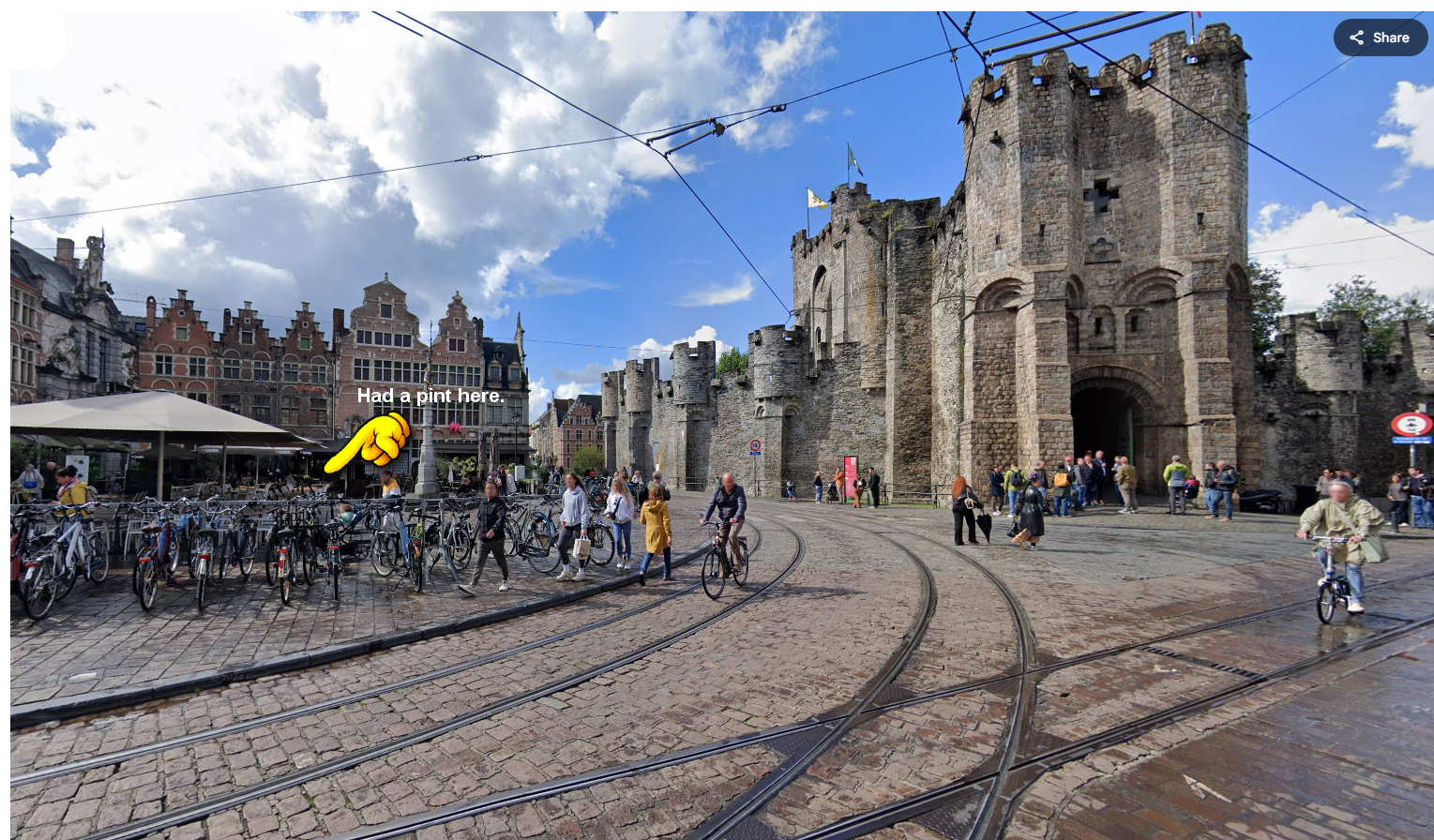
Ghent, castle, beer, trams and awesomeness.
Day 5 and, as I said, there was coffee again. I’m very easy to please in the morning.
I couldn’t find a TV news channel that spoke English, but I assumed that World War 3 hadn’t broken out overnight.
Ironically, today was to be the day of the lost and fallen from an earlier conflict.
I skipped dessert for breakfast and went for something more yoghurt and fruit based.
Massive carbohydrate loading was unnecessary for this style of riding but that had to be balanced with the fact we were on holiday and a breakfast of doughnuts, cakes and chocolate was therefore entirely acceptable.
As we set off towards Ypres, small signs at the roadside marked various successes and failures from the Great War. Road signs pointed to places with names that were familiar yet completely unknown; familiar names simply because you knew they were sites of various degrees of slaughter and destruction over a century ago.
We stopped in the afternoon, at Tyne Cot cemetery and memorial, the largest Commonwealth War Graves Commission cemetery in the world, the final resting place of 12,000 servicemen, more than 8,300 of whom remain unidentified.
Most of them fell during the Battle of Passchendaele.
The memorial also bears the names of the 35,000 that died yet have no grave. They are still out there somewhere, waiting to be tilled to the surface or exposed during construction of the next wind turbine.
Entering Ypres through the Menin Gate, a memorial with the names of a further 54,000 missing servicemen did nothing to lighten the sombre mood.
There, at 8.00pm, every day, a bugler sounds the Last Post for those lost.
It’s important that we never forget the sacrifice that our countrymen made a century ago but it makes for a very heavy day. I’m not sure what the take-home is from visiting these places.
My family on both sides were miners and we’ve no rollcall of family members lost in the Great War, they were all too busy digging. The further we get from the events of the past the less significance they seem to have.
The same is true of coal mines.
Just to cheer us up, our hotel owner, Chris, was as wide as you could imagine.
He only had four guests, all of them Fridays (it was a small hotel) and he even ran us back into town once we’d all freshened up.
We bumped into a group of fellow Fridays taking advantage of “Thursday night is steak night” and likewise had a steak.
Day 6 was only a 70km day back to Dunkirk. It was probably shorter, but we appeared to do a few laps of Ypres, reaching the desired escape velocity before shooting off in the direction of Boezinge where we stopped to take a look at the Yorkshire Trench & Dug-out, a trench and command post complex accidentally discovered by a farmer in 1992, and now a site of historical interest, nestled in a large industrial estate and next to what clearly smelled like an anaerobic digestion plant.
Is it me, but does the cartoon signboard of the site look like the soldiers were having too much of a spiffing, jolly time rather than a dying in their thousands, misery?
It was not a place to linger – the nostrils just couldn’t cope.
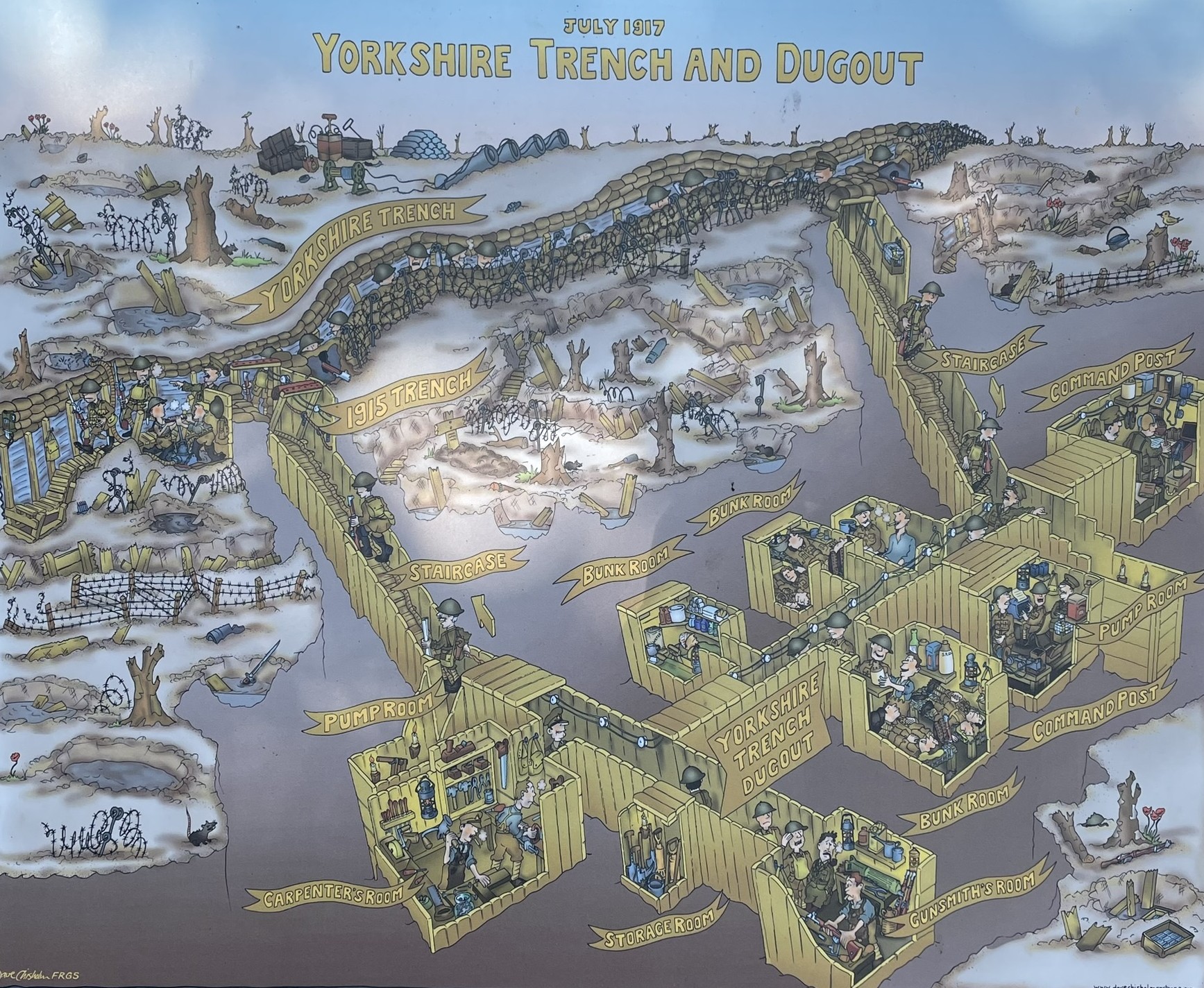
I can’t help think that life in the trenches was somewhat less fun than the image suggests
The tour section of sadness and depression had one last page as we stopped at the German cemetery at Langemark.
In marked contrast to Tyne Cot there were 44,300 soldiers interred here, far more, half of them in a mass grave. Even those identified lay beneath simple, engraved markers listing the 16 bodies buried beneath. I heard the quoted motto, “comrades in life – comrades in death”, as some sort of noble finality. I couldn’t help thinking it was just the cheapest way of burying the bodies and the quote was something usefully apt.
It was easy to imagine that as “the losers”, the Germans were permitted to bury and honour their fallen but within a very strict set of rules and a minimal budget.
These really are not places to linger.
So, we trundled back into Dunkirk, completing the loop, back to the same hotel, with no bedroom coffee-making facilities. At least this time it didn’t come as a shock.
Of course, I made out that it was.
With very few rushing off to grab the evening ferry there was an excellent turnout for the end of tour dinner.
The following day we retraced our route back to the ferry and likewise through Dover, St Pancras, Paddington, Cardiff and finally up to Caerphilly.
This time we managed it smoothly without a sniff of a bus-replacement service and managed to cycle back to the front door – completing the circuit.
I can’t mention Belgium without briefly mentioning its cycling infrastructure.
Our journey this time took us through France, Belgium and the Netherlands. The odd border crossing into the Netherlands didn’t really highlight any change in the cycling infrastructure whereas in France it was noticeably worse.
Worse, of course, on a scale where the UK doesn’t even get listed…
Belgium has a cycleway network, the use of which is compulsory, but as it is efficient and has priority over the roads, it’s rather silly to use anything else.
The motorists are “cyclist aware” through decades of quality investment in cycling infrastructure and appear more patient and tolerant of those on two wheels.
It is infuriating how poor the UK is in comparison.
If you get the chance to try it, you won’t be disappointed.
Now, I think it’s high time I owned a Brompton…
 The Reluctant Wanderer...